
You’re texting a friend, you share your day, and they reply with “HBU?” If you paused for even a second wondering what that meant, you’re not alone. This tiny abbreviation shows up in millions of chats every day, yet plenty of people still aren’t 100% sure what it stands for or when it’s okay to use.
This guide breaks down everything you need to know about HBU its full form, where it comes from, how to use it correctly, and when you should probably skip it altogether.
🧠 What Does HBU Mean in Conversation?
HBU is short for “How About You?” It’s a quick way to turn a conversation back to the other person after you’ve answered a question or shared something about yourself.
Instead of typing out the full phrase, people shorten it to four letters to save time and keystrokes. It’s the texting equivalent of tossing the ball back to whoever you’re talking to.
Example:
“I’m just chilling at home, HBU?”
Here, the sender is saying “I’m relaxing at home, what about you?” in the shortest way possible.
What Is HBU Mean?
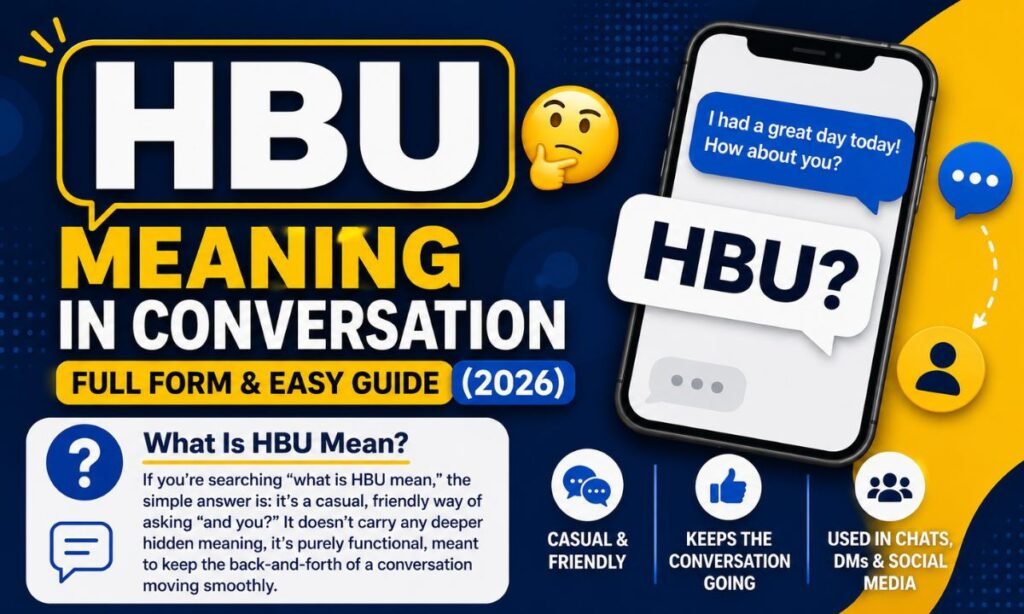
If you’re searching “what is HBU mean,” the simple answer is: it’s a casual, friendly way of asking “and you?” It doesn’t carry any deeper hidden meaning, it’s purely functional, meant to keep the back-and-forth of a conversation moving smoothly.
📱 Where Is HBU Commonly Used?
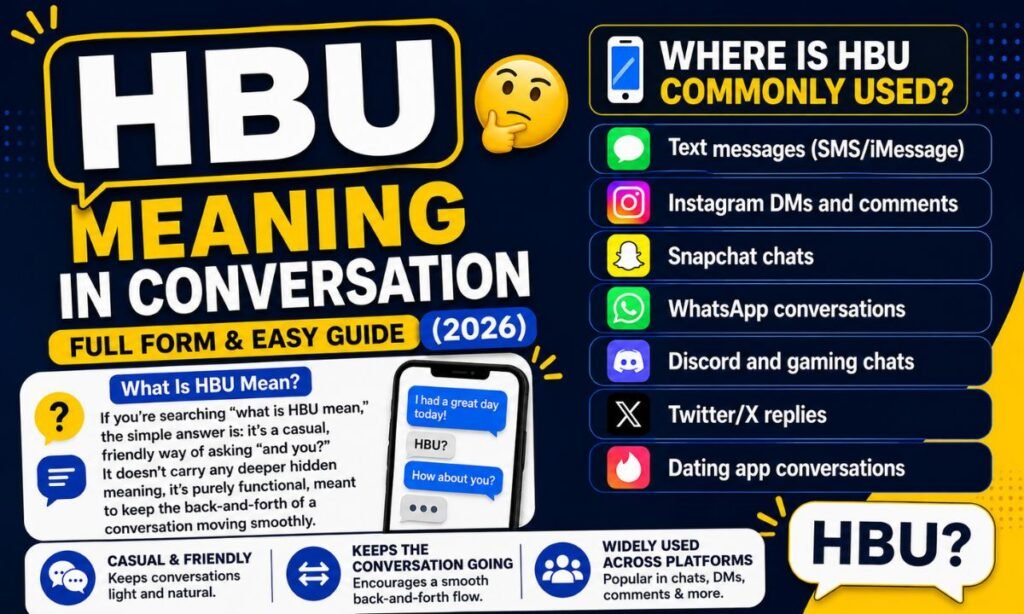
HBU shows up mostly in informal, text-based communication. You’ll spot it in:
- Text messages (SMS/iMessage)
- Instagram DMs and comments
- Snapchat chats
- WhatsApp conversations
- Discord and gaming chats
- Twitter/X replies
- Dating app conversations
It’s especially popular among teens and young adults who chat constantly throughout the day and prefer short, efficient typing over full sentences.
Tone Check
The tone of HBU is generally neutral to friendly. It’s not rude, and it’s not overly formal; it sits right in the middle. That said, the exact vibe can shift slightly depending on:
- Who’s sending it (a close friend vs. a new acquaintance)
- What emojis or punctuation come with it
- The context of the conversation (casual chat vs. flirty exchange)
A plain “HBU?” feels neutral. A “HBUUU 😄” feels playful and warm.
💬 Examples of HBU Meaning in Conversation
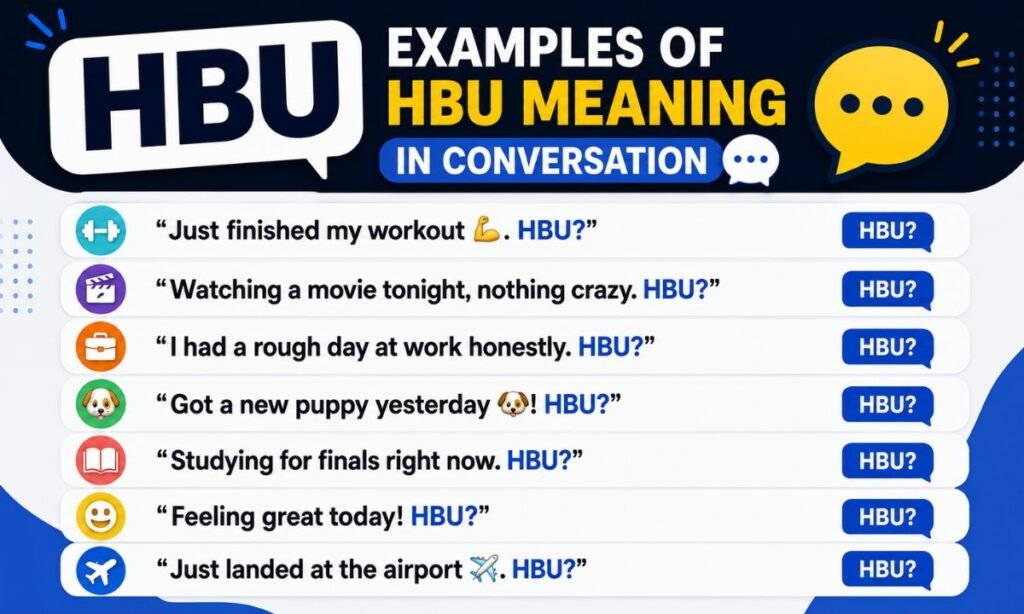
Here are some real-world examples to show how naturally HBU fits into everyday chats:
- “Just finished my workout 💪. HBU?”
- “Watching a movie tonight, nothing crazy. HBU?”
- “I had a rough day at work honestly. HBU?”
- “Got a new puppy yesterday 🐶! HBU?”
- “Studying for finals right now. HBU?”
- “Feeling great today! HBU?”
- “Just landed at the airport ✈️. HBU?”
In every case, HBU does the same job it hands the conversational turn back to the other person.
🕓 When to Use and When Not to Use HBU
Knowing when HBU fits (and when it doesn’t) is the real key to sounding natural instead of awkward.
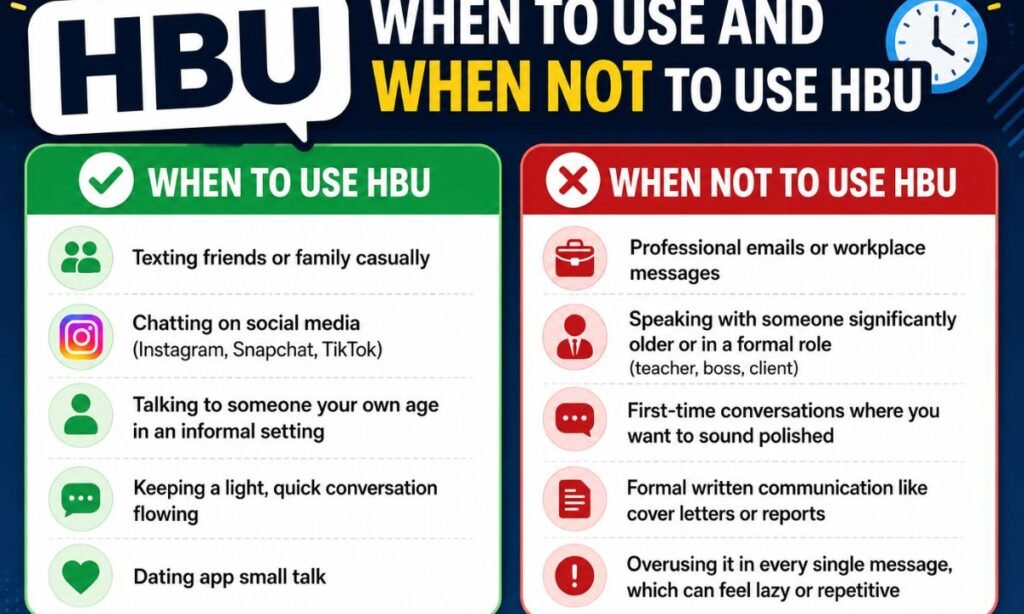
✅ When to Use HBU
- Texting friends or family casually
- Chatting on social media (Instagram, Snapchat, TikTok)
- Talking to someone your own age in an informal setting
- Keeping a light, quick conversation flowing
- Dating app small talk
❌ When Not to Use HBU
- Professional emails or workplace messages
- Speaking with someone significantly older or in a formal role (teacher, boss, client)
- First-time conversations where you want to sound polished
- Formal written communication like cover letters or reports
- Overusing it in every single message, which can feel lazy or repetitive
Quick rule of thumb: if you wouldn’t say “how about you” out loud in that setting, skip HBU too.
Other Meanings of HBU
While “How About You?” is by far the most common meaning, HBU can occasionally stand for something else depending on context:
| Context | Alternate Meaning |
| Gaming/online communities | “Hit Back Up” (reconnect later) |
| Academic/college references | Houston Baptist University |
| Casual spoken-style texting | A relaxed variant of “how about you” |
Outside of texting slang, these alternate meanings are far less common, so context always matters when decoding what someone meant.
🔄 Similar Slang Words or Alternatives
HBU isn’t the only abbreviation used to bounce a question back. Here’s how it compares to similar terms:
| Abbreviation | Full Form | Tone/Usage |
| HBU | How About You? | Casual, most common |
| WBU | What About You? | Nearly identical, slightly more casual |
| HBY | How Bout You? | Very informal, spoken-style |
| HMU | Hit Me Up | Invitation to talk, not a direct question |
| WYD | What You Doing? | Asking about current activity |
| UR | You Are | Different meaning entirely — not a question return |
Also Read this Meaning ICL Meaning
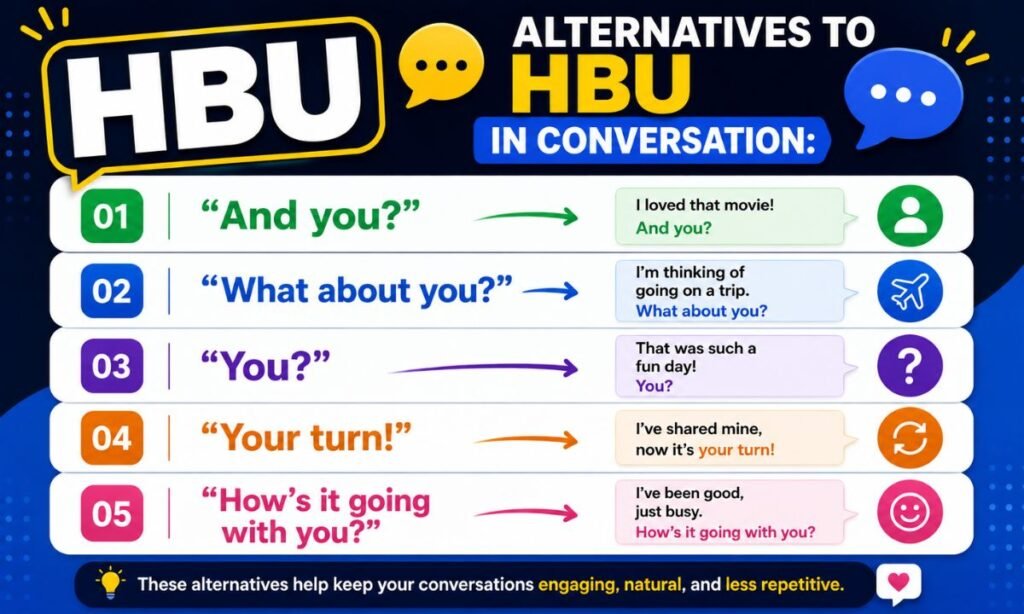
Alternatives to HBU in conversation:
- “And you?”
- “What about you?”
- “You?”
- “Your turn!”
- “How’s it going with you?”
Any of these work well as substitutes, especially in slightly more formal or thoughtful conversations.
Origins of HBU and Early Internet Slang
HBU has roots in the early days of texting, when SMS messages were often limited by character count and, in many cases, cost money per message. Shortening common phrases wasn’t just trendy, it was practical.
As instant messaging platforms like AIM, MSN Messenger, and early mobile texting grew popular in the 2000s, users developed a whole vocabulary of abbreviations (LOL, BRB, TTYL, and eventually HBU) to keep up with fast-paced typing. Teenagers chatting for hours after school needed shortcuts, and HBU became one of the standard ones.
By the time smartphones and social media took over, HBU had already cemented itself as a staple of digital conversation.
How Americans Use HBU in Everyday Chats
In the U.S., HBU is treated as a completely normal, everyday texting habit especially among teens, college students, and young professionals in casual settings. It’s used interchangeably with “what’s up” style check-ins and rarely raises an eyebrow in personal conversations.
It’s common to see it paired with brief updates:
“Just got home from class, HBU?”
Americans also tend to mix HBU freely with other slang like “lol,” “ngl,” or emojis, layering it into a broader casual texting style rather than using it in isolation.
HBU in Social Media Platforms Like Instagram and Snapchat
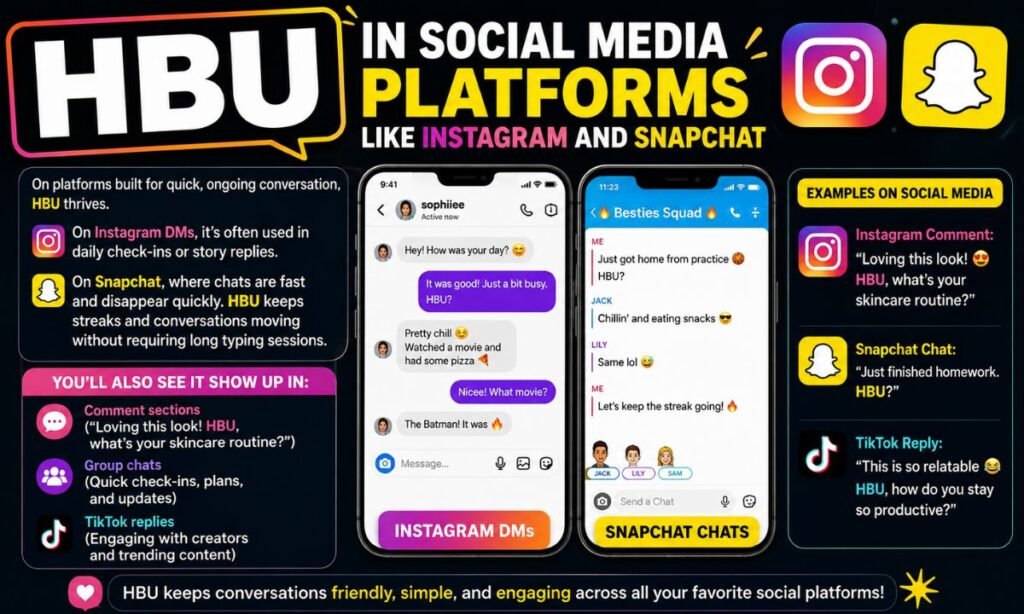
On platforms built for quick, ongoing conversation, HBU thrives. On Instagram DMs, it’s often used in daily check-ins or story replies. On Snapchat, where chats are fast and disappear quickly, HBU keeps streaks and conversations moving without requiring long typing sessions.
You’ll also see it show up in:
- Comment sections (“Loving this look! HBU, what’s your skincare routine?”)
- Group chats
- TikTok replies
Emojis are frequently paired with it to soften or add personality think “HBU? 😊” versus a plain “HBU?”
HBU vs Other Common Text Abbreviations
| Feature | HBU | WBU | HMU |
| Meaning | How About You | What About You | Hit Me Up |
| Function | Returns a question | Returns a question | Invites contact |
| Formality | Casual | Casual | Very casual |
| Common platforms | Texting, IG, Snapchat | Texting, IG | Texting, social media |
The key difference to remember: HBU and WBU are near-identical, while HMU serves a completely different purpose it’s an invitation, not a question.
Also Read this Meaning In Text IMK Mean in Text
Emotional and Psychological Meaning of HBU
On the surface, HBU looks purely functional, but it also plays a small social role. Asking “HBU?” shows the other person that you’re interested in them too — it signals reciprocity and keeps the conversation feeling balanced rather than one-sided.
Leaving it out entirely (just answering a question without asking it back) can sometimes come across as self-focused or disengaged, even if that’s not the intention. In that sense, HBU functions as a small but meaningful gesture of conversational courtesy.
Professional vs Casual Use of HBU
| Setting | Recommended? | Better Alternative |
| Texting friends | ✅ Yes | — |
| Social media DMs | ✅ Yes | — |
| Work Slack/Teams (casual team chat) | ⚠️ Sometimes | “How about you?” |
| Client emails | ❌ No | “How are you doing?” |
| Job interviews | ❌ No | “And yourself?” |
In professional writing, spelling out the full phrase almost always reads as more polished and shows more effort, even if it takes a few extra seconds to type.
Common Misunderstandings About HBU
- Mistaking it for rudeness HBU is brief, but brevity isn’t the same as rudeness. Context and tone matter more than the abbreviation itself.
- Confusing it with unrelated abbreviations like “UR” or assuming it always means the college (Houston Baptist University).
- Assuming it’s flirty by default it can be, but only when paired with flirty context, not on its own.
- Overusing it in every reply, which can start to feel robotic or lazy rather than genuinely curious.
Is HBU Rude or Friendly? Context Matters
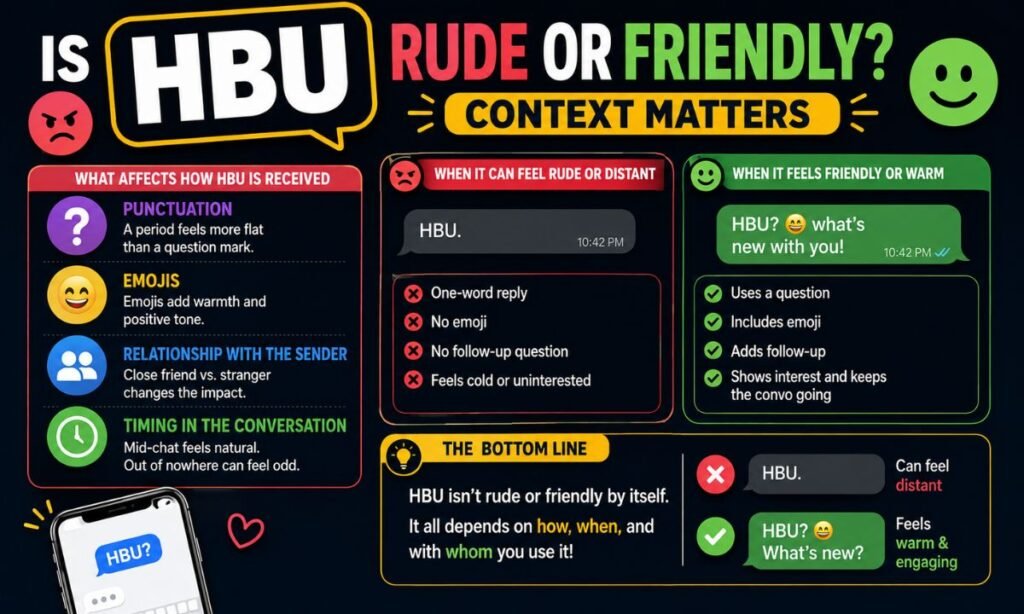
By itself, HBU is neither rude nor overly friendly; it’s neutral. What shapes its tone is everything around it:
- Punctuation (a period feels more flat than a question mark)
- Emojis (add warmth)
- Relationship with the sender (close friend vs. stranger)
- Timing in the conversation (mid-chat vs. out of nowhere)
A one-word “HBU.” with no emoji and no follow-up can sometimes feel a little distant, while “HBU? 😄 what’s new with you!” reads as warm and engaged.
Cultural and Cross-Cultural Use of HBU
HBU is primarily an English-language texting abbreviation, most popular in the U.S., U.K., Canada, and other English-speaking regions. As global internet culture spreads through platforms like TikTok and Instagram, it has also become recognizable to non-native English speakers, especially younger users who consume a lot of English-language social media content.
In many non-English-speaking countries, people now mix HBU into conversations alongside their native language, similar to how “lol” or “omg” have become globally recognized.
Evolution of HBU in 2025–2026 Digital Communication
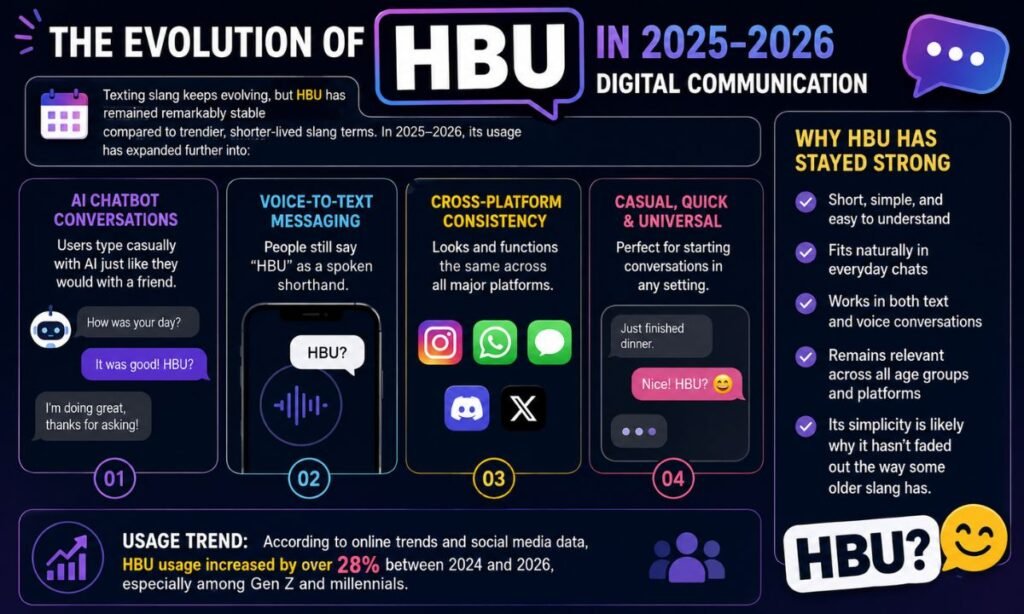
Texting slang keeps evolving, but HBU has remained remarkably stable compared to trendier, shorter-lived slang terms. In 2025–2026, its usage has expanded further into:
- AI chatbot conversations, where users type casually just like they would with a friend
- Voice-to-text messaging, where people still say “HBU” as a spoken shorthand
- Cross-platform consistency, meaning it looks and functions the same on Instagram, WhatsApp, iMessage, or Discord
Its simplicity is likely why it hasn’t faded out the way some older slang has.
Examples of HBU in Sentences
- “I’m doing pretty good today, HBU?”
- “Just finished dinner, HBU? Did you eat yet?”
- “Work was crazy busy. HBU, how was yours?”
- “I’m free this weekend, HBU?”
- “Feeling kind of tired ngl, HBU?”
Also Read this Meaning TT Meaning On Tiktok
Frequently Asked Questions
Is HBU rude?
No. HBU is a neutral, casual abbreviation. It only feels rude if the surrounding tone or context is dismissive, not because of the abbreviation itself.
Is HBU formal?
No, HBU is informal and best suited for casual texting or social media, not professional or formal communication.
Is HBU the same as WBU?
Almost. HBU means “How About You?” while WBU means “What About You?” they’re used interchangeably in most casual chats.
Can HBU be used on social media?
Yes, HBU is extremely common on Instagram, Snapchat, TikTok, and Twitter/X, especially in DMs and comments.
Should I use HBU in emails?
It’s best to avoid HBU in emails, especially professional ones. Use the full phrase “How about you?” instead for a more polished tone.
Final Thoughts
HBU might just be four letters, but it plays a real role in keeping digital conversations warm, balanced, and easy to follow. Once you understand its meaning, tone, and the right situations to use it, you’ll never second-guess a text again.
Stick to casual chats and social media for HBU, switch to the full phrase for anything formal, and you’ll always sound natural whether you’re texting a friend or replying to a comment online.
