
You get a message that says “gd.” No punctuation, no explanation. Is it a friendly greeting, a frustrated outburst, or something else entirely?
GD in text most commonly means “good day” or “good,” and in a more emotional context it stands for “god damn.” Which one applies depends on the tone, the sender, and the conversation around it.
This guide explains both meanings, shows real-style examples, and helps you decode GD in any chat.
What Does GD Mean in Text?
GD is a two-letter abbreviation with more than one meaning in texting. The two you’ll see most often are below.
GD Meaning as “Good Day”
In a friendly or neutral message, GD is shorthand for “good day” (and sometimes just “good”). People use it to say hello, sign off, or show quick approval.
- “Gd! Talk later.”
- “Have a gd one.”
It reads as warm, short, and low-effort. You’ll mostly see it in casual chats where people are typing fast.
GD Meaning as “God Damn”
In a heated or emphatic message, GD stands for “god damn” (or “goddamn”). It works as a softened, abbreviated way to type a mild curse word.
- “This traffic is gd unbelievable.”
- “Gd it, I forgot my keys.”
Here the abbreviation adds emphasis or frustration. Some people use it to avoid typing the full phrase.
Where Is GD Commonly Used?
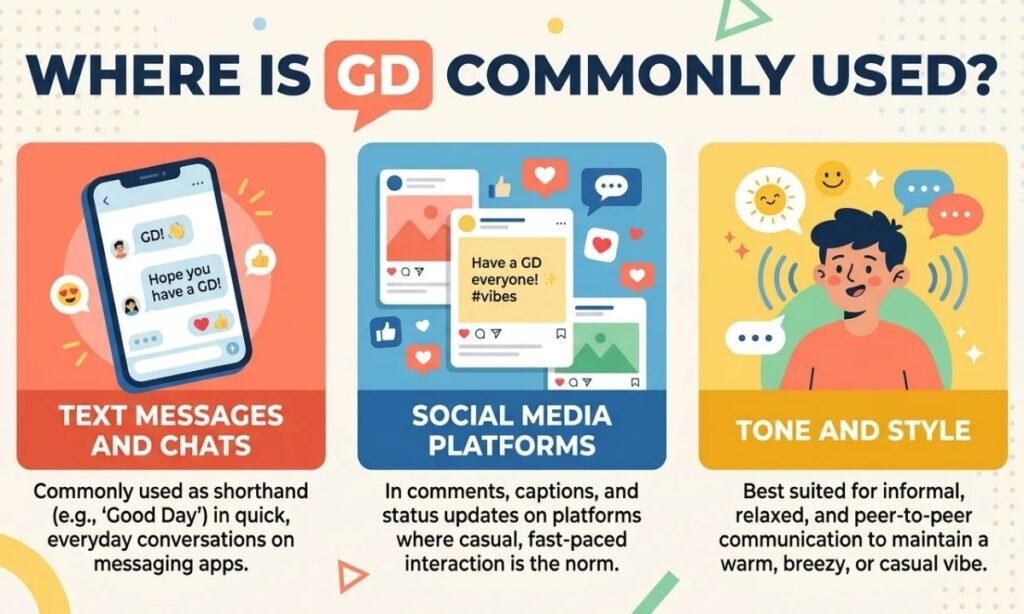
Text Messages and Chats
GD appears most in private, informal conversations: SMS, iMessage, WhatsApp, and similar apps. Speed is the main reason. Two letters beat six.
Social Media Platforms
On Snapchat, Instagram DMs, X (Twitter), and TikTok comments, GD shows up in captions, replies, and quick reactions. Short-form platforms reward short-form language, so abbreviations spread fast there.
Tone and Style
GD is almost always:
- Lowercase or all caps (“gd” or “GD”)
- Casual and unpolished
- Dependent on context to carry its meaning
There’s no punctuation rule. A cheerful “gd!” and an annoyed “gd.” can mean completely different things.
What Does GD Mean in Text Messages?
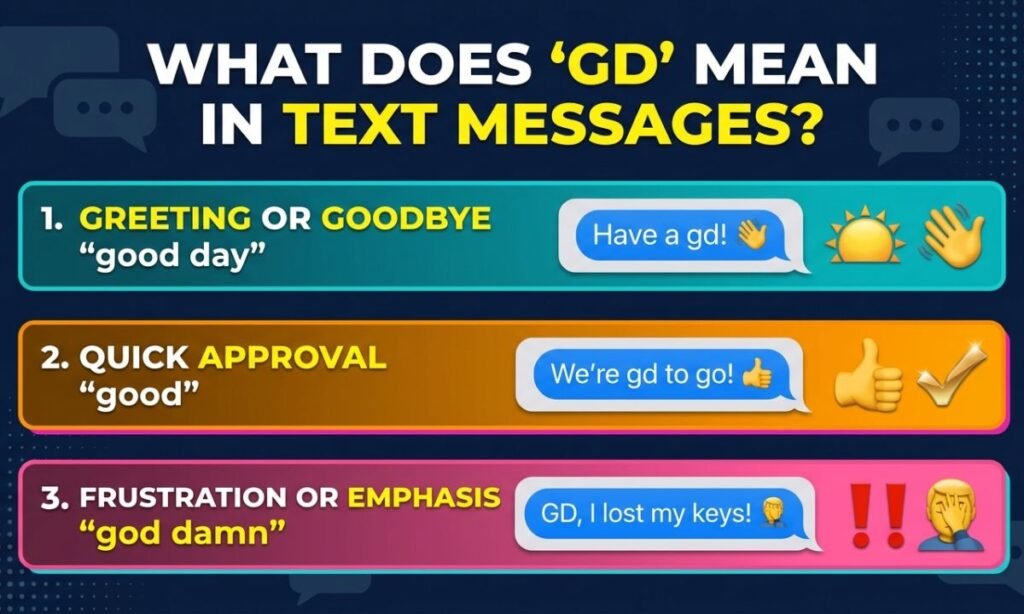
In text messages specifically, GD usually falls into one of three buckets:
- Greeting or goodbye: “good day”
- Quick approval: “good”
- Frustration or emphasis: “god damn”
If the message is short, upbeat, and near the start or end of a chat, assume “good day.” If it sits inside a complaint, assume “god damn.”
Examples of GD in Conversation
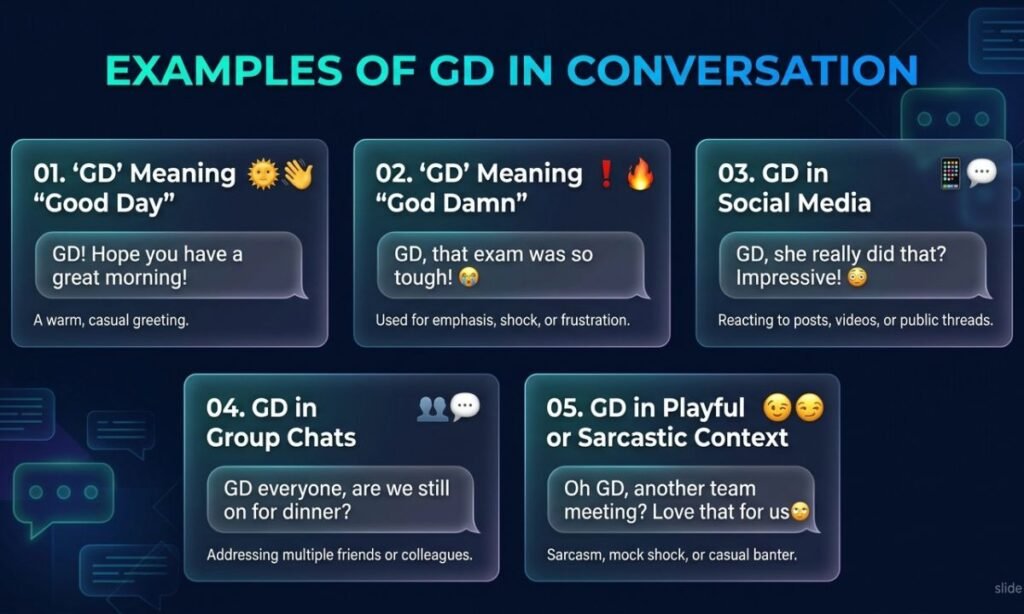
GD Meaning “Good Day”
A: Heading out to a meeting.
B: Ok, gd!
A: Thanks for the help today.
B: Anytime. Gd.
GD Meaning “God Damn”
A: Did you finish the report?
B: Gd, I completely forgot.
A: Why is the Wi-Fi down again?
B: This is gd ridiculous.
GD in Social Media Conversations
Comment: Just got my results back.
Reply: gd work!! (meaning “good” work)
Story reply: Missed the bus for the third time 😩
Friend: gd it lol
GD in Group Chats
Friend 1: Dinner at 8?
Friend 2: Gd with me.
Friend 3: Same, gd.
In group chats, GD often works as a fast “good with me” vote. It keeps the thread moving without long replies.
GD in a Playful or Sarcastic Context
A: I only slept two hours.
B: Gd morning to you too, sunshine 😂
A: Your cooking attempt?
B: A gd masterpiece. Smoke alarm included.
Sarcasm can flip the meaning. Emojis, exaggeration, and surrounding jokes are your best clues.
How to Tell Which Meaning of GD Someone Means
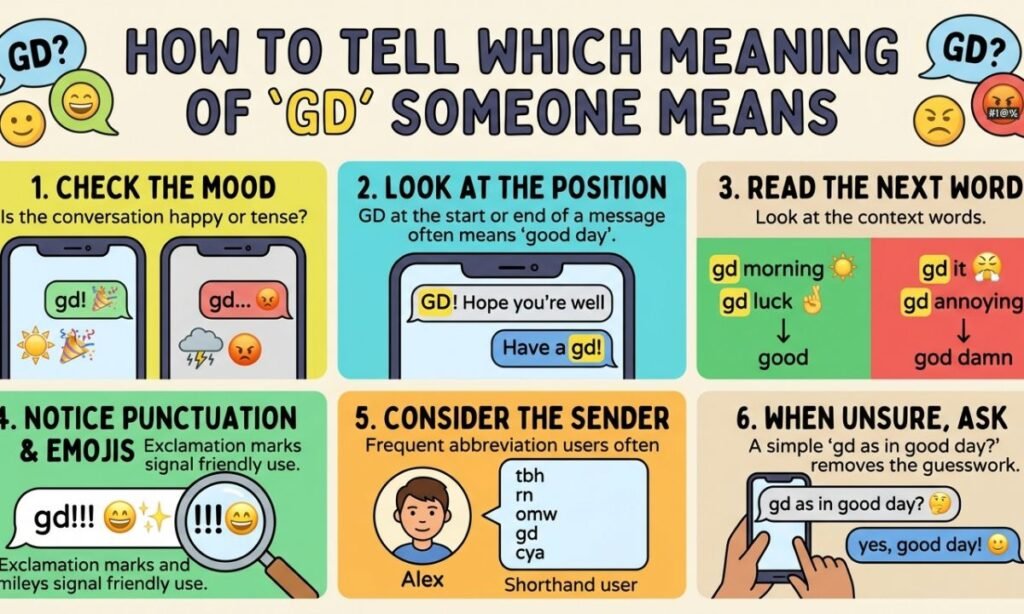
Use this quick checklist:
- Check the mood. Is the conversation happy or tense?
- Look at the position. GD at the start or end of a message often means “good day.”
- Read the next word. “Gd morning” or “gd luck” points to “good.” “Gd it” or “gd annoying” points to “god damn.”
- Notice punctuation and emojis. Exclamation marks and smileys usually signal friendly use.
- Consider the sender. Someone who regularly shortens words is probably just abbreviating “good.”
- When unsure, ask. A simple “gd as in good day?” removes the guesswork.
Quick reference table:
| Clue | Likely Meaning |
| “Gd morning,” “gd night,” “gd luck” | Good |
| “Gd!” at the end of a friendly chat | Good day |
| “Gd it,” “gd annoying,” “gd late” | God damn |
| Paired with 😂 or 😊 | Friendly or playful |
| Paired with 😡 or all caps | Frustrated |
Why Do People Use GD in Texting?
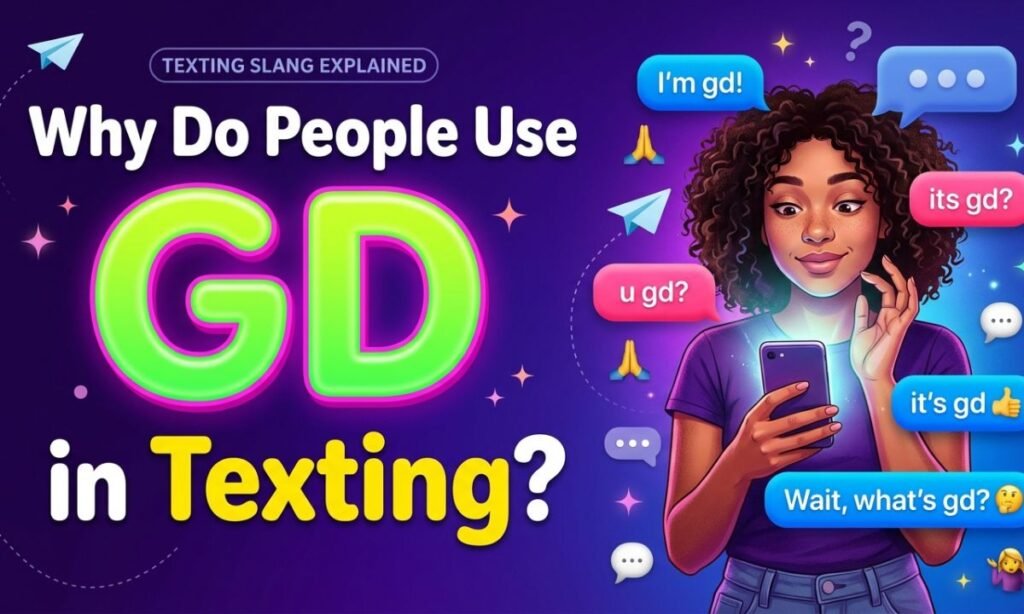
People use GD for a few simple reasons:
- Speed: Fewer letters, faster replies.
- Habit: Texting culture favors shortcuts like “gm,” “gn,” and “ty.”
- Softening language: “Gd” feels lighter than typing a full curse.
- Casual tone: It signals a relaxed, informal vibe.
- Platform style: Short captions and DMs reward brevity.
Is GD Friendly, Neutral, or Rude?
It depends on which meaning is in play.
Friendly or Neutral Use
As “good day” or “good,” GD is harmless. It’s polite, brief, and casual. Most people read it as a quick acknowledgment.
Strong or Emotional Use
As “god damn,” GD carries more edge. It can sound annoyed, angry, or dramatic. Some people find it mildly offensive, especially those who see the phrase as disrespectful for religious reasons. Even in abbreviated form, the tone is still strong.
When to Use GD and When Not to Use It
When to Use GD
- Chatting with friends or family
- Replying quickly in a group chat
- Giving a casual thumbs-up (“gd with me”)
- Signing off in an informal conversation
When Not to Use GD
- Professional emails or work messages, where clarity matters
- Messages to people you don’t know well, since it may be misread
- Customer support or formal communication
- Any situation where “god damn” could be assumed, such as when the person is already upset
When in doubt, type the full word. “Good” takes two extra seconds and prevents confusion.
Other Meanings of GD in Text
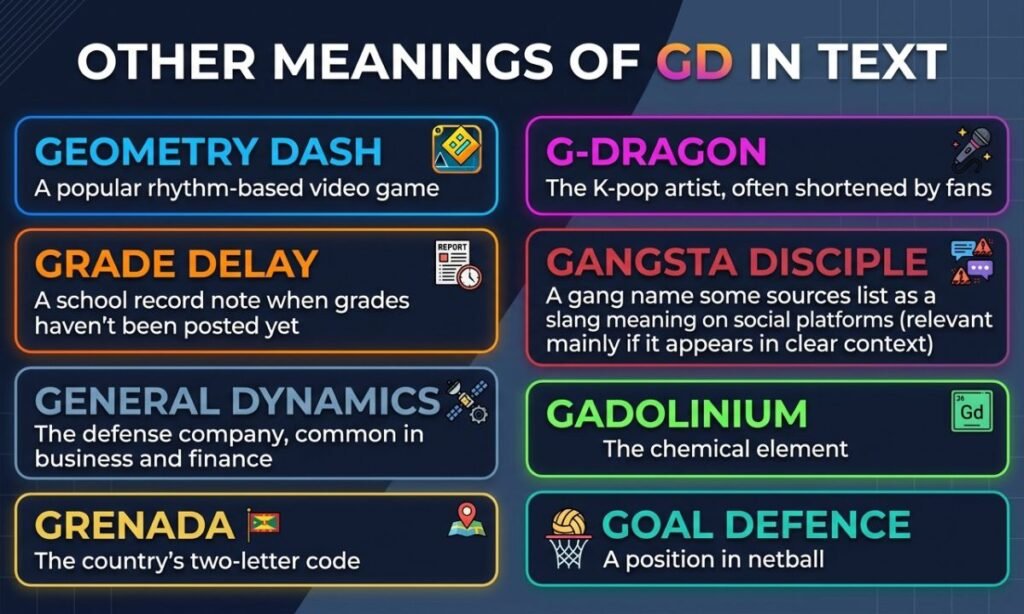
GD is a busy abbreviation. Depending on the setting, it can also stand for:
- Geometry Dash: a popular rhythm-based video game
- G-Dragon: the K-pop artist, often shortened by fans
- Grade delay: a school record note when grades haven’t been posted yet
- Gangsta Disciple: a gang name some sources list as a slang meaning on social platforms (relevant mainly if it appears in clear context)
- General Dynamics: the defense company, common in business and finance
- Gadolinium: the chemical element
- Grenada: the country’s two-letter code
- Goal defence: a position in netball
Outside a texting context, these are far more likely in news, work documents, or hobby communities than in casual chats.
Also Read Meaning FS Mean
Similar Slang Words and Alternatives to GD
Here are common shortcuts that serve a similar purpose:
| Abbreviation | Meaning |
| GM | Good morning |
| GN | Good night |
| GL | Good luck |
| GG | Good game |
| TY | Thank you |
| K / KK | Okay |
| GTG | Got to go |
| BRB | Be right back |
Clearer alternatives to GD:
- “Good day” (friendly, slightly formal)
- “Sounds good”
- “Have a great one”
- “Goodness” or “gosh” (for a gentler exclamation than the curse)
Also Read Meaning TD Mean in Text
Frequently Asked Questions About GD Mean in Text
What does GD stand for in texting?
GD most often stands for “good day” or “good,” and sometimes “god damn” in emotional messages.
What does GD mean on social media?
On social platforms, GD usually means “good” or “good day,” but it can also be a mild curse depending on the tone.
Can GD mean “Good Day”?
Yes. In friendly greetings and goodbyes, GD is a common shortcut for “good day.”
Can GD mean “God Damn”?
Yes. In frustrated or emphatic messages, GD is used as a shortened form of “god damn.”
Is GD rude?
Not by default. As “good day” it’s polite, but as “god damn” it can come across as rude or harsh.
Can GD be used professionally?
It’s best avoided at work because its meaning is unclear. Write “good” or “good day” instead.
How can I tell which meaning of GD is intended?
Check the tone, the surrounding words, and any emojis, or simply ask the sender to clarify.
Final Thoughts on GD Mean in Text
GD is a small abbreviation with a split personality. In most friendly chats, it means “good day” or “good.” In heated moments, it stands in for “god damn.”
Context is everything. Look at the mood, the neighboring words, and the sender’s habits. If you’re writing to someone new, or in a work setting, spell it out and skip the guesswork.
Understanding abbreviations like GD helps you read messages correctly and reply with the right tone every time.

1 thought on “What Does GD Mean in Text? Meaning, Uses & Examples (2026)”