
If you’ve been scrolling through TikTok comments, Snapchat replies, or a group chat and spotted the word “ion” sitting where a full sentence should be, you’re not alone in wondering what it means. It’s not a typo, and it’s not the science term from your old chemistry textbook either.
In this guide, you’ll learn exactly what ION means in text, where it came from, how it’s used across different apps, and when you should (or shouldn’t) drop it into your own conversations.
What Does ION Mean in Text?
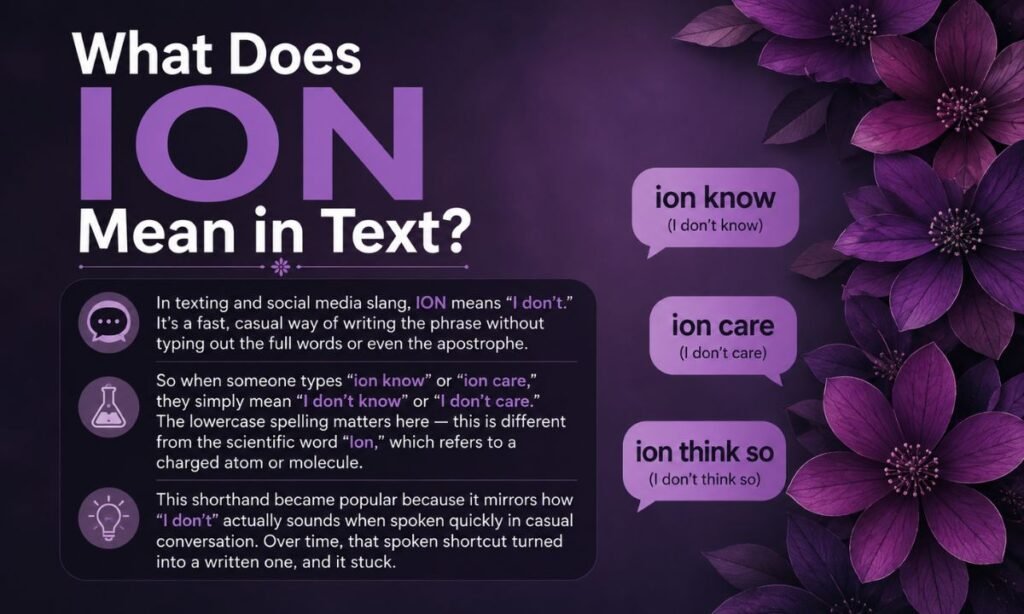
In texting and social media slang, ION means “I don’t.” It’s a fast, casual way of writing the phrase without typing out the full words or even the apostrophe.
So when someone types “ion know” or “ion care,” they simply mean “I don’t know” or “I don’t care.” The lowercase spelling matters here — this is different from the scientific word “Ion,” which refers to a charged atom or molecule. In everyday texting, context makes it obvious which one is meant, and 99% of the time, it’s the slang version.
This shorthand became popular because it mirrors how “I don’t” actually sounds when spoken quickly in casual conversation. Over time, that spoken shortcut turned into a written one, and it stuck.
What Does ION Stand for?
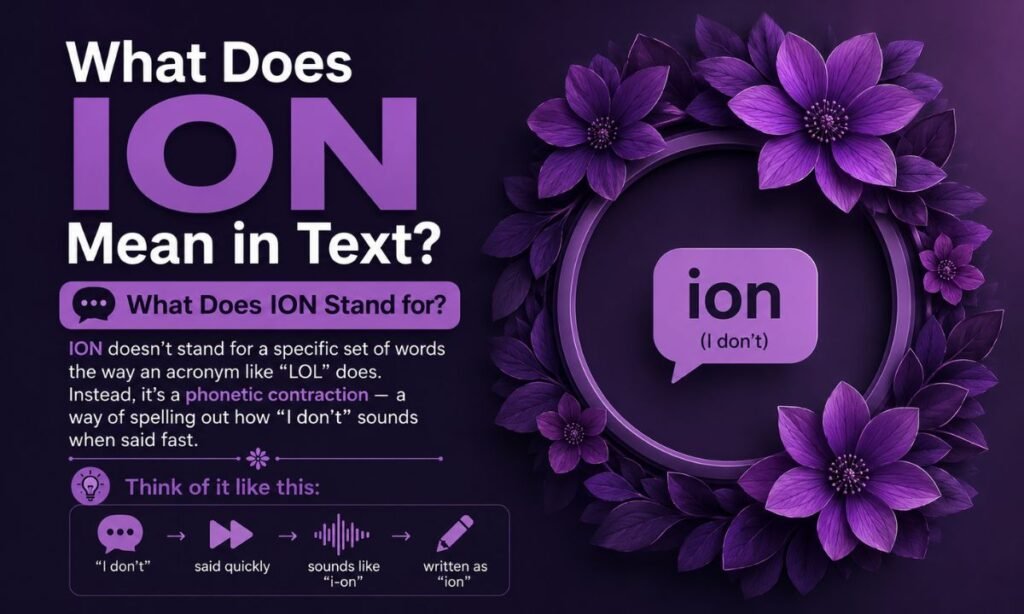
ION doesn’t stand for a specific set of words the way an acronym like “LOL” does. Instead, it’s a phonetic contraction — a way of spelling out how “I don’t” sounds when said fast.
Think of it like this:
- “I don’t” → said quickly → sounds like “i-on” → written as “ion”
It’s less of an abbreviation and more of a texting shortcut born from natural speech patterns, similar to how “going to” became “gonna” in casual writing.
Where Is ION Commonly Used?
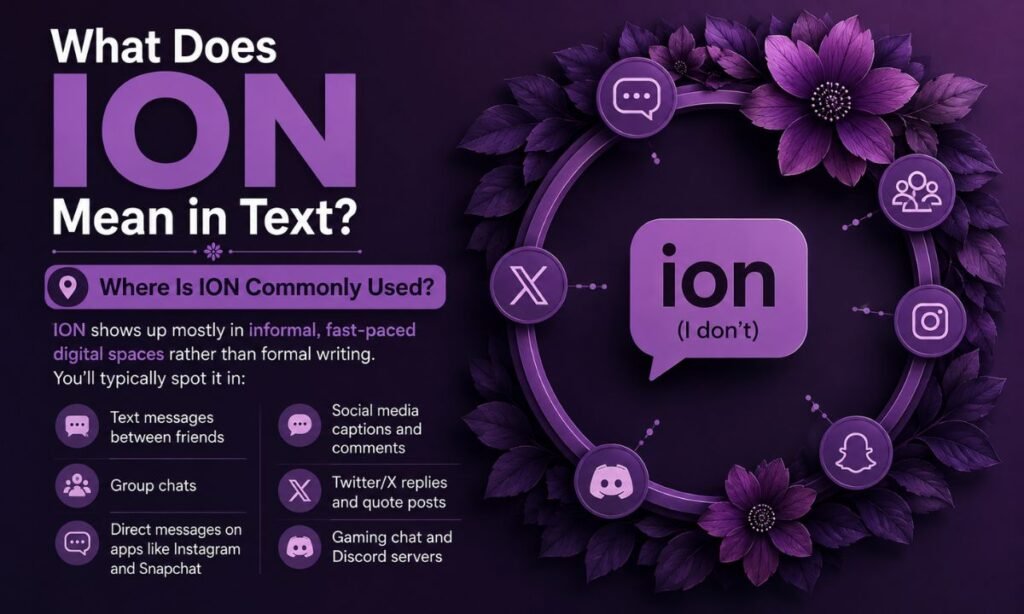
ION shows up mostly in informal, fast-paced digital spaces rather than formal writing. You’ll typically spot it in:
- Text messages between friends
- Social media captions and comments
- Group chats
- Direct messages on apps like Instagram and Snapchat
- Twitter/X replies and quote posts
- Gaming chat and Discord servers
It’s especially common among younger users, particularly Gen Z, and has roots in African American Vernacular English (AAVE) before spreading into mainstream internet slang through platforms like TikTok and Twitter.
ION Mean on Snapchat, TikTok, Instagram & Text?
The meaning of ION stays the same no matter which app you’re using — it always means “I don’t.” What changes slightly is the tone and frequency depending on the platform:
| Platform | How ION Is Typically Used |
| Snapchat | Quick, casual replies to snaps or chats, often paired with emojis |
| TikTok | Comments and captions, sometimes for humor or relatable content |
| DMs and comment sections, usually among friends or followers | |
| Text Messages (SMS) | Everyday texting between friends or in group chats |
| Twitter/X | Short, punchy replies or quote tweets |
No matter the platform, ION keeps the same casual, laid-back energy. It’s built for speed and informality, not formal communication.
Examples of ION in Conversation
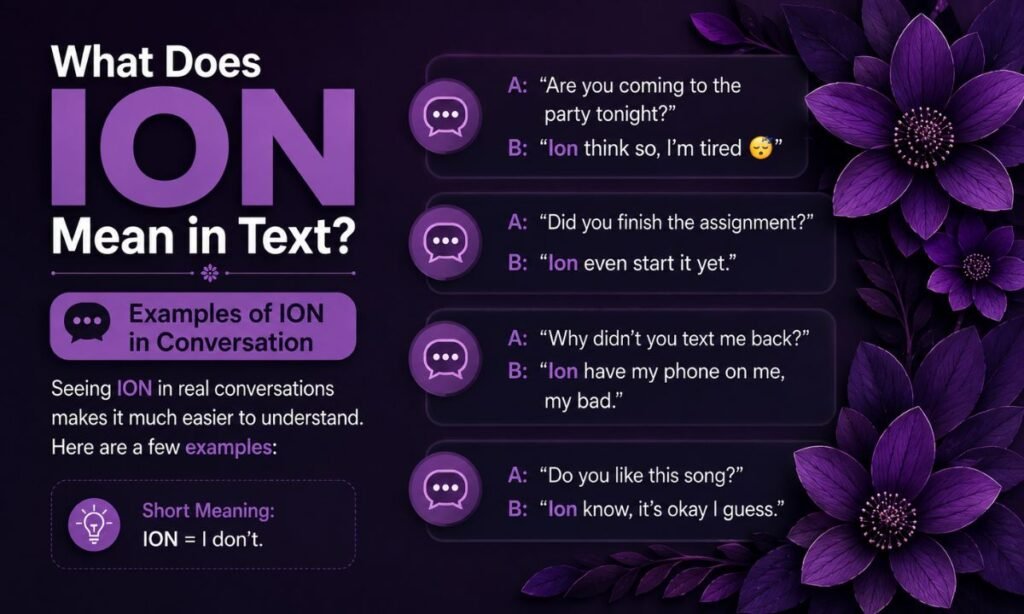
Seeing ION in real conversations makes it much easier to understand. Here are a few examples:
- A: “Are you coming to the party tonight?” B: “Ion think so, I’m tired 😴”
- A: “Did you finish the assignment?” B: “Ion even start it yet.”
- A: “Why didn’t you text me back?” B: “Ion have my phone on me, my bad.”
- A: “Do you like this song?” B: “Ion know, it’s okay I guess.”
In each case, ION simply replaces “I don’t,” keeping the message short, natural, and conversational.
ION in Different Texting Contexts
ION can shift slightly in feeling depending on how it’s used, even though the core meaning stays the same. Here’s a quick breakdown:
- Casual/Neutral: “Ion watch horror movies.” (Simple statement of preference)
- Dismissive: “Ion care what they think.” (Can sound blunt without added context)
- Playful: “Ion know how you survived that 😂” (Light, joking tone)
- Uncertain: “Ion think that’s a good idea.” (Expressing doubt, not full refusal)
Because texting lacks tone of voice, the words and emojis around ION usually determine whether it reads as chill, dismissive, or playful.
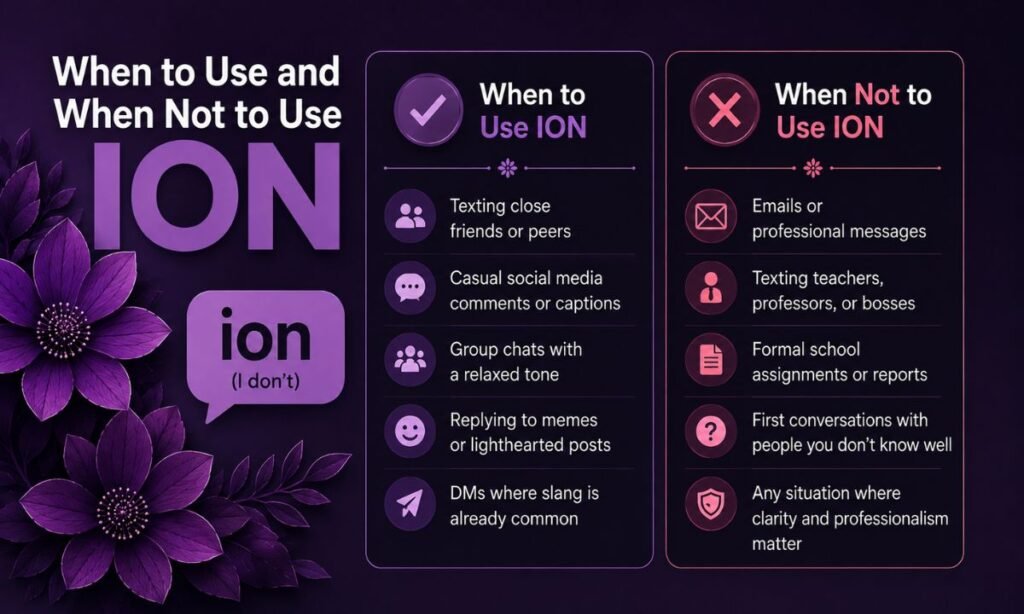
When to Use and When Not to Use ION
Like most slang, ION works well in some situations and poorly in others. Knowing the difference helps you avoid sounding out of place.
When to Use ION
- Texting close friends or peers
- Casual social media comments or captions
- Group chats with a relaxed tone
- Replying to memes or lighthearted posts
- DMs where slang is already common
When Not to Use ION
- Emails or professional messages
- Texting teachers, professors, or bosses
- Formal school assignments or reports
- First conversations with people you don’t know well
- Any situation where clarity and professionalism matter
A simple rule of thumb: if you wouldn’t say “I don’t” out loud in a stiff, formal tone during that conversation, ION probably doesn’t belong there either.
Is ION Vs IDK and Other Similar Slang Words
ION often gets compared to other texting abbreviations, especially IDK. While they can overlap, they aren’t always interchangeable.
ION Vs IDK
| Term | Meaning | Example |
| ION | I don’t | “Ion like that show.” |
| IDK | I don’t know | “IDK what to wear tonight.” |
The key difference is that ION replaces “I don’t” as a general phrase, while IDK specifically means “I don’t know.” ION is more flexible and can be followed by almost any verb (“ion care,” “ion think,” “ion feel”), while IDK is locked into expressing uncertainty.
ION Vs Other Casual Alternatives
| Term | Meaning |
| IDC | I don’t care |
| ILY | I love you |
| IMO | In my opinion |
| TBH | To be honest |
| NGL | Not gonna lie |
These terms often appear alongside ION in the same casual conversations, all serving the same purpose: keeping digital communication fast and low-effort.
Also Read Meaning OSNS Mean in Text
Is ION the Same as the Scientific Word “Ion”?
No. The scientific term “ion” refers to an atom or molecule that has gained or lost electrons, giving it an electric charge — something you’d learn about in a chemistry class. It’s spelled the same way but has absolutely nothing to do with texting slang.
The two meanings almost never get confused in real conversations because context makes the difference obvious. “We studied ions in chemistry” is clearly scientific, while “ion know what to do” is clearly slang. If you ever see it and aren’t sure, just look at the sentence around it — that’s usually all it takes.
Also Read Meaning SFS Mean In Text
FAQs About What Does ION Mean in Text
Does ION mean something scientific in texting?
No. In texting, ION is slang for “I don’t.” The scientific meaning only applies in academic or chemistry-related contexts.
Is ION rude?
Not inherently. It’s informal but not disrespectful — tone and context determine whether it comes across as dismissive.
Can I use ION with everyone?
It’s best used with friends, peers, or people comfortable with casual slang, not in formal or professional settings.
Is ION the same as IDK?
Not exactly. ION means “I don’t,” while IDK specifically means “I don’t know.”
Is ION flirty?
By itself, no. But paired with playful emojis or a teasing tone, it can come across as flirty.
Should I use ION in school or work messages?
No. Stick to full phrases like “I don’t” in formal writing, emails, or professional communication.
Final Thoughts
ION is a small piece of internet slang with a simple meaning: “I don’t.” It’s fast, casual, and perfect for texting friends, commenting on social media, or keeping group chats light and easy. Just remember to save it for informal conversations and switch to full phrases when writing anything professional or formal.
Now that you know what ION means in text, you’ll never have to pause and wonder the next time it pops up in your messages.
